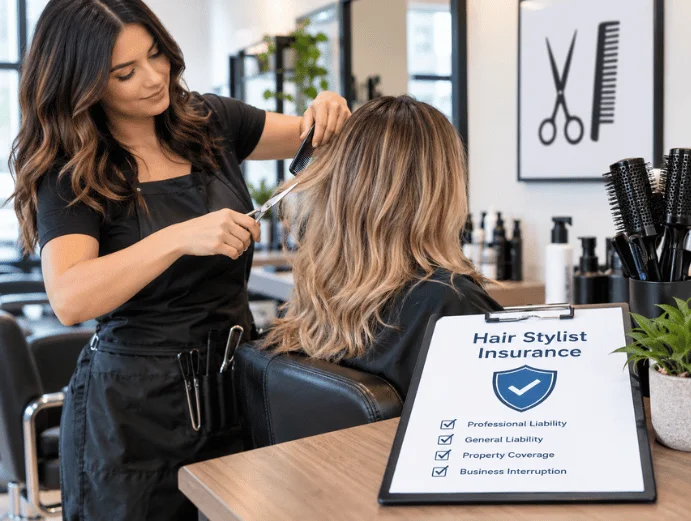
Hair stylist insurance can protect independent stylists, booth renters, mobile professionals, and salon owners from costly business claims. Coverage may respond when a client gets hurt, property gets damaged, or a service allegedly causes an injury. The right policy depends on where you work, what services you provide, and whether you employ anyone.
Quick answer: Most stylists should consider general liability and professional liability coverage. Independent policies are currently advertised from roughly $10 to $26 monthly, although actual premiums vary. Salon owners may also need property, business income, workers’ compensation, cyber, or commercial auto coverage depending on their operations.
| Insurance question | Practical answer |
|---|---|
| Who may need coverage? | Independent stylists, booth renters, mobile stylists, salon owners, and employers |
| Core coverages | General liability and professional liability |
| Common claim examples | Slips, burns, allergic reactions, cuts, damaged belongings, and service-related allegations |
| Current advertised starting prices | Roughly $10–$26 monthly for some individual liability products |
| Salon-owner additions | Property, business income, workers’ compensation, cyber, and commercial auto |
| Booth renters | Often need their own individual policy |
| Mobile professionals | Should confirm coverage follows them away from a fixed salon |
| Proof of coverage | Insurers commonly provide a certificate of insurance, or COI |
Key Takeaways
- General liability addresses many third-party injury and property-damage claims.
- Professional liability addresses allegations connected with your professional services.
- Booth renters may need coverage separate from the salon owner’s policy.
- Salon owners usually face broader property and employment risks.
- Workers’ compensation requirements depend on state law and employment arrangements.
- Cheap coverage is not useful if important services or locations are excluded.
What Does Hair Stylist Insurance Cover?
Hair stylist insurance usually refers to several business coverages rather than one universal policy. General liability and professional liability are the two protections most independent professionals review first. Some specialty insurers combine both within one package designed for beauty professionals.
General liability can address third-party bodily injury and property damage arising from ordinary business operations. A client slipping near a shampoo station is a common example. Damage to a customer’s belongings may also fall within this coverage, depending on policy terms.
Professional liability focuses on claims tied to the services you perform. Examples can include alleged burns, cuts, chemical reactions, or damage attributed to a treatment. Coverage wording differs, so you should check whether every service you provide appears within the policy’s eligible activities.
Why Stylists Face More Than One Type of Risk
Hair services combine close physical contact, chemicals, hot tools, sharp equipment, and customer property. That creates risks that ordinary retail businesses may not face in the same way. Even experienced professionals can encounter accidents that lead to medical bills or legal disputes.
Consider a color service that causes an unexpected scalp reaction. A client could allege the service caused the injury and demand reimbursement. Professional liability may respond if the incident meets the policy’s coverage requirements.
Now consider a client who slips on water near a sink. That claim concerns the premises rather than the quality of the haircut or treatment. General liability is normally the coverage designed for that category of third-party accident.
What Types of Insurance Should a Hair Professional Consider?
Your business setup determines which policies deserve attention. An independent booth renter usually has different exposures from someone operating a multi-chair salon. The table below shows the common distinctions.
| Coverage | What it generally addresses | Who should consider it |
|---|---|---|
| General liability | Third-party injuries and property damage | Most independent stylists and salon businesses |
| Professional liability | Claims arising from professional services | Anyone providing hair or beauty services |
| Commercial property | Business equipment, furnishings, inventory, or premises | Salon owners and professionals with valuable equipment |
| Business income | Certain lost income following a covered property loss | Businesses dependent on a physical location |
| Workers’ compensation | Employee work-related injuries or illnesses | Employers where state rules require coverage |
| Commercial auto | Vehicles used for covered business purposes | Mobile businesses using business vehicles |
| Cyber liability | Certain data breaches and digital risks | Businesses storing client or payment information |
A Businessowners policy, usually called a BOP, can combine property and general liability protection. It may also include business income coverage. The Insurance Information Institute notes that professional liability and workers’ compensation normally require separate protection.
That distinction matters when comparing quotes. A package described as “salon insurance” may not automatically include every risk your business faces. Read the coverage list, exclusions, deductibles, and limits before comparing policies by price.
How Much Does Coverage Cost in the United States?
Pricing varies because insurers evaluate different business characteristics and coverage choices. Your services, location, claims history, limits, equipment, revenue, and staffing can affect the premium. A solo booth renter should not expect the same price as a salon employing several professionals.
Current specialty-provider pricing shows how wide the market can be. Beauty & Bodywork Insurance advertises individual coverage from $9.99 monthly, while NACAMS lists coverage around $14.91 monthly. Simply Business currently advertises certain hairstylist professional liability options from $25.83 monthly.
Those numbers are advertised starting prices, not guaranteed quotes for every applicant. Broader salon packages can cost considerably more because they insure additional property, employees, locations, or operations. Progressive also notes that location, employees, revenue, equipment, limits, and claim history can affect salon pricing.
Booth Renters and Independent Stylists Need to Check Their Own Coverage
Renting a chair does not automatically mean the salon’s policy protects your individual work. The salon owner may insure the premises while requiring independent professionals to maintain separate liability protection. Some salon agreements also require the owner to appear as an additional insured.
Ask for the insurance requirements before signing a booth agreement. Confirm the required liability limits, additional-insured wording, and certificate requirements. Then compare those terms against the policy you plan to purchase.
Independent service businesses should treat insurance as part of their startup budget. Biznovaa’s guide to choosing a low-cost business explains why operating costs matter before launching a service company.
Mobile Stylists Should Confirm Where Their Policy Applies
Mobile professionals have an extra question because they work away from one permanent location. Some specialty policies advertise portable protection for eligible work performed at client homes or other approved locations. Still, policy territory and service restrictions can differ between insurers.
Tell the insurer exactly how you operate before purchasing coverage. Mention home visits, weddings, events, rented suites, shared salons, and interstate travel when applicable. Written confirmation is safer than assuming a policy follows you everywhere.
This same planning principle applies across mobile service businesses. Biznovaa’s event-planning business guide includes insurance among the legal and operating considerations new service providers should evaluate.
What Salon Owners May Need Beyond Basic Liability
A salon owner has risks that an individual service provider may never encounter. Furniture, inventory, fixtures, equipment, lease obligations, employees, and business interruption can increase potential losses. Property and business income protection may therefore become more important as the operation grows.
A BOP can bundle several common small-business protections into one package. Triple-I explains that these policies commonly combine property, liability, and business income coverage. Professional liability, workers’ compensation, and commercial auto generally require separate consideration.
Ownership also changes the financial consequences of a shutdown or major claim. Buyers evaluating an established salon should review insurance expenses alongside leases, equipment, payroll, and other obligations. Biznovaa’s overview of businesses for sale explains why operating liabilities deserve close review before buying an existing company.
Workers’ Compensation Rules Depend on Your State
Workers’ compensation is especially important once a business hires employees. Requirements for private employers are handled primarily through state systems rather than one nationwide rule. The U.S. Department of Labor directs employers to their individual state workers’ compensation authority.
That means a salon owner should not rely on a generic national checklist. Employee count, worker classification, state law, and other factors can change the requirement. Check your state agency or speak with a licensed insurance professional before assuming coverage is optional.
Independent contractors and booth renters create another classification issue. Insurance requirements and employment classification are separate legal questions. A contract calling someone independent does not automatically settle every state employment or insurance requirement.
How to Compare Policies Without Focusing Only on Price
Start by writing down every service you perform. Include coloring, bleaching, extensions, chemical treatments, bridal styling, mobile appointments, and any related beauty services. A low-cost policy has little value when a major service falls outside its coverage terms.
Next, compare limits, deductibles, exclusions, policy form, territory, and additional-insured options. Check whether tools, rented premises, product-related claims, and mobile work require endorsements. Ask when the insurer issues a certificate of insurance and how additional insureds are added.
Finally, compare insurers using the same coverage assumptions. One quote may appear cheaper because it provides lower limits or excludes something another policy includes. Price becomes meaningful only after the coverage is reasonably comparable.
Questions to Ask Before You Buy Hair Stylist Insurance
Use a written checklist when requesting quotes. It reduces the chance of overlooking a service or business arrangement. Keep the answers with your policy records after purchasing coverage.
- Are all my current hair services eligible?
- Does coverage apply at rented booths and client homes?
- What general and professional liability limits apply?
- Is the policy occurrence-based or claims-made?
- Are tools and supplies insured?
- Can I add a salon owner or landlord as an additional insured?
- Are product-related claims included or excluded?
- What deductible applies to each coverage?
- How quickly can I obtain a certificate of insurance?
- Which exclusions could affect my highest-risk services?
Common Mistakes That Can Leave Coverage Gaps
One mistake is buying the cheapest policy without checking eligible services. Another is assuming the salon owner’s insurance protects every independent contractor. Both errors can become expensive after a claim occurs.
Professionals also forget to update policies after changing locations or adding services. New treatments, additional staff, and expensive equipment can alter the business risk. Review coverage whenever your operations change materially.
Another problem is mixing personal and commercial insurance assumptions. Personal auto or homeowners coverage may exclude certain business losses. Ask the insurer directly when business property, vehicles, or home-based operations are involved.
FAQ
How much does hair stylist insurance cost?
Some U.S. specialty providers currently advertise individual liability plans starting around $10 to $26 per month. Your actual premium can be higher based on services, limits, location, claims history, and business size. Salon owners usually pay more because their insurance needs extend beyond individual professional liability.
Do booth renters need their own insurance?
Many booth renters carry separate coverage because the salon’s policy may not insure their professional services. A rental agreement may also require proof of liability insurance. Review both the contract and policy wording before beginning work.
What insurance protects against a client slipping in a salon?
General liability commonly addresses third-party bodily injury claims such as qualifying slip-and-fall accidents. Coverage still depends on the policy terms, limits, exclusions, and circumstances. Report any incident promptly according to your insurer’s claims procedures.
What insurance covers a bad haircut or chemical injury claim?
Professional liability is generally designed for allegations arising from professional services. Chemical reactions, burns, cuts, or other treatment-related allegations may fall within this category. Coverage depends on whether the service and event meet the policy terms.
Is insurance legally required for every self-employed stylist?
There is no single U.S. rule making the same business policy mandatory for every independent professional nationwide. Requirements can depend on state law, contracts, leases, employees, and business structure. Check state rules and any salon agreement that applies to your work.
Protect the Business You Built
Insurance cannot prevent every accident, but it can reduce the financial impact of covered claims. Start with the risks created by your services, workplace, equipment, and staffing. Then compare policies based on coverage before comparing premiums.
Before buying hair stylist insurance, request quotes using the same limits and business details. Confirm every service, work location, and important exclusion in writing. A licensed insurance professional can help explain state-specific requirements and policy differences.
This article provides general educational information for U.S. readers. It does not provide legal, tax, or individualized insurance advice.